TOPICS & NEWS
Articles and interviews on current trends, technology and industry challenges, information on our consulting services, seminars and events as well as company topics:
Here you can find out what drives EFESO.
Interview
How Industrial AI Reconnects Production and Automation
Experte: André Nowak | 07/29/2026 | Teilen auf in
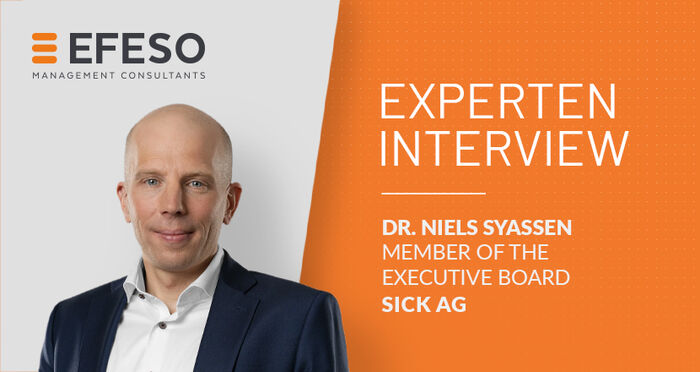
As a member of the Executive Board, Dr. Niels Syassen is responsible for the Technology & Solutions division at SICK AG. In the EFESO interview, he explains how companies can gradually make established brownfield structures data-enabled, scale use cases effectively, and deploy AI in a way that supports people in production processes rather than replacing them.
What should companies in your industry focus on when it comes to digitalization and automation? Are there, for example, particular strategic or operational potentials that should be addressed more strongly?
Dr. Niels Syassen: In industrial automation, companies should focus specifically on transforming their production and logistics landscapes. The greatest potential lies in gradually connecting, standardizing, and making these historically grown and often fragmented brownfield structures data capable.
This fragmentation is precisely what slows down many Industry 4.0 initiatives: different machines, systems, and technologies make it difficult to scale best practices quickly and limit the scope for end-to-end automation solutions. However, companies that address this point in a targeted way can realize enormous efficiency gains. A pragmatic approach is important here: rather than relying on large-scale, one-off transformations, companies should identify specific use cases, implement them, and scale them systematically.
In fact, this approach is already being applied in practice by the winners of the INDUSTRIE 4.0 AWARD and many other companies. While isolated “lighthouse projects” often dominated in the past, we are now increasingly seeing integrated solutions that combine multiple use cases and create real added value.
But it does not stop at the orchestration of use cases. At the latest when it comes to scaling, the issue of “speed of implementation” also becomes relevant …
Dr. Niels Syassen: Exactly, but it is not just about that. Companies need to deliberately master digitalization and automation technologies and translate them into measurable productivity—in other words, create value. Technologies such as cloud, AI, data platforms, and virtualization have long been available. The decisive factor, however, is to actively understand them, test them, and evaluate their concrete benefits within one’s own environment.
At the same time, technology alone quickly reaches its limits. Companies need to clearly define where they want to go with digitalization and AI, which use cases deliver the greatest added value, and which objectives they pursue. Building on this, implementation must be driven forward consistently and step by step. In addition to the iterative approach with scalable use cases already mentioned, this also requires a well-thought-out orchestration of competencies—in other words, the interplay between employees and their skills in working with these technologies. However, this also requires an open learning culture that leaves room for experimentation and mistakes. A culture in which approaches can sometimes be discarded and restarted.

How can companies professionalize their Industry 4.0 implementation by taking such a progressive approach?
Dr. Niels Syassen:By proceeding in a focused and iterative way. In principle, many options and ideas can quickly be brought to the table, but not every one of them creates added value. Successful companies therefore first define clear domains, meaning specific areas with potential, for example within production. There, they systematically collect ideas and develop suitable use cases in collaboration with all employees affected by the use case.
The next step is then to consciously start small. Instead of trying to build perfect solutions right away, the initial focus is on experimentation: testing with manageable effort, learning quickly, and finding out whether real potential exists. If an approach proves successful, the pilot phase follows. At this stage, the solution is already used productively in a specific area in order to gather experience under real conditions.
Basically, such an approach is founded on classic innovation models with clear decision stages: after each phase, it is assessed whether it makes sense to continue. This allows companies to learn quickly, avoid overinvestment, and build competencies step by step at the same time. And from my perspective, this iterative approach is a decisive success factor for Industry 4.0.
It is also important to understand that this approach differs significantly from classic optimization projects. It is no longer just about making existing processes more efficient, but about exploratively developing new solutions. This requires a genuine culture of innovation—and the ability to consistently learn and establish this new way of working within the company.
A large share of INDUSTRIE 4.0 AWARD applicants are already applying AI, though their focus areas and expected outcomes differ significantly. How do you assess the current “AI impact” in manufacturing companies? Where do you still see untapped fields of action?
Dr. Niels Syassen: There is no question that the existing impact of AI is just as remarkable as the incredible speed and dynamism with which technology is evolving. The performance of AI is practically doubling every few months at constant cost. Or, conversely, the same applications are becoming significantly cheaper within a very short period of time. But this also creates a new key challenge for companies: anyone implementing an AI use case today can no longer plan in the traditional way over a ten-year horizon. Instead, flexible, modular architectures are needed that function independently of individual models. After all, the models will continue to change, and new providers will enter the market. Accordingly, the fast-moving technology layer must be clearly decoupled from the actual use case layer. Otherwise, companies are constantly forced to revisit fundamental decisions and lose valuable speed.
In the coming years, we can expect a correspondingly exponential and rapid development of “Industrial AI” solutions: robust, practical AI solutions that provide guidance in manufacturing, simplify decision-making, increase efficiency, and boost productivity. Particularly exciting: classic structures such as the automation pyramid are increasingly being broken down. Through AI and digitalization, network-like architectures are emerging instead, in which new use cases can be flexibly added. As a result, companies are much less rigidly tied to their systems. And this, in turn, opens up entirely new possibilities and business areas.
Which task or process could an AI use case address?
Dr. Niels Syassen: In SICK’s production, for example, AI is used in equipment troubleshooting. Imagine that a problem occurs somewhere in production at night—but the experienced employees who would normally know immediately what to do are not on site.
This is where our AI use case helps: the operator on site does not have to wait for information from other employees. They simply speak or write to our system, in any language. Language barriers practically no longer play a role. This makes the interaction between humans and machines simple and low-threshold. The AI automatically processes the information, asks follow-up questions if needed, and directly creates a ticket.
AI does not replace people; it augments our work processes.The case is then forwarded to a globally available service technician. The technician immediately sees all relevant information, can access live machine data, and receives additional support in troubleshooting—for example, from another AI agent that draws on error patterns and experience gathered over the past 20 years.
We are also already moving into the field of “agentic industrial AI” in our sensor production: AI independently carries out certain actions in the system without requiring constant human intervention. This creates a tremendous productivity boost in troubleshooting. And this is precisely where I see the true, particularly exciting potential of AI: AI does not replace people; it augments our work processes.

What do you mean by this “augmentation”? And to what extent can it shape the role of humans in the future evolution of automation?
Dr. Niels Syassen: Manual processes will certainly continue to exist in many production environments in the future. Not every production process can be fully automated—either because certain work steps are too complex, do not scale well, or because a machine-based solution would simply be too expensive. For these reasons, people remain a central part of manufacturing. It becomes particularly exciting where AI specifically supports people and thereby significantly improves productivity and quality.
A good example is quality control, for instance at the “quality gates” at the end of a production step. The problem here is that if an error is detected at this stage, it has already occurred. With AI, this approach can be shifted much earlier in the process. For example, if an employee performs a highly complex soldering process on special components, an AI-supported camera can monitor the process in real time. It checks the soldering temperature, detects whether the correct contacts are being connected, and immediately provides feedback if something is not right. This makes it possible to prevent errors before they even occur. People remain indispensable, but they are supported and relieved by intelligent systems.
And yes, the role of humans in production is, of course, changing. New task profiles are emerging, and this requires a willingness to develop further and build new skills. Those who plan and orchestrate processes will increasingly work with AI-supported engineering assistants in the future. Employees on the shop floor, too, will not only need to master their actual tasks, but also learn how to work effectively with AI systems, assistants, or copilots. Skill development, training, and continuous relearning will therefore become even more important in the future.
In addition to AI, do you see another trend—whether technological or arising from the broader conditions of industrial transformation—that will significantly influence the importance of Industry 4.0?
Dr. Niels Syassen: Digital twins are finding new fields of application on a much larger scale than before, as standards have now been established and are moving into broad application. One example is the “Asset Administration Shell”: this framework enables components such as sensors to be digitally described in a standardized way, including all technical features, documentation, and software information. Companies can download these digital twins directly and integrate them automatically into their own systems, such as PLM or engineering systems.
For example, if a machine builder uses sensors from different manufacturers, the data can be automatically integrated and updated in the future. This saves a tremendous amount of manual effort, for instance when email coordination or the exchange of different data formats is no longer required. Here, too, the major added value lies in efficiency: in use cases with industrial partners, we have found that engineering times can be reduced by 30 to 50 percent in this way. For machine builders, this is a real game changer.
In addition, the industry is increasingly moving toward virtual planning and simulation. In the future, production systems will first be fully built and tested digitally before any physical implementation takes place. Companies can simulate whether a system functions optimally, how flexibly it can be expanded, or how individual components behave during operation. Virtualization technologies already make this possible today, including realistic physical properties and functional models. Interestingly, the technological foundation of these virtual worlds is very similar to AI in many areas. At the same time, open standards such as OpenUSD—originally from the film and gaming industry—are also emerging here and are increasingly establishing themselves as industrial standards. I am convinced that a large part of development, testing, and optimization will first shift into the virtual world in the future before systems are actually rolled out.