

AI Consultant Delivers 100% Process Power
With an AI-supported delivery model from EFESO, a battery manufacturer is professionalizing its development processes.
A globally established battery manufacturer wants to make a complex R&D approval process faster, more transparent, and scalable. EFESO assembles a team of experienced process experts and an “AI consultant” that analyzes interviews, creates process models, and identifies improvement opportunities. Together, the team develops six validated target processes, prioritizes more than 40 measures, and identifies a feasible efficiency improvement potential of approximately 30%.
Challenge
A complex R&D approval process created inefficiencies. Fragmented data, unclear responsibilities, and a lack of transparency slowed collaboration. A fast, scalable solution was required.
MoreEFESO success model
A clear path from analysis to implementation: EFESO translates more than 40 measures into a prioritized implementation roadmap and links them to clearly defined performance targets.
MoreComplexity Restricts the Flow of Energy
“Energy for countless everyday moments” is the core business of this EFESO client. Whether in a flashlight during a power outage, a toy that comes to life, or a measuring device that must operate independently, the long-established corporation and its batteries are present in more than 100 markets. Meeting high performance standards and continuously raising the bar are firmly embedded in the company’s culture. Continuous improvement is a top priority, reflected both in the high quality of its products and in its exemplary operational processes.
In this case, the decision-making and approval process within one area of R&D provided management with a valuable opportunity to raise the efficiency of teamwork to a new performance level. From both a technological and operational perspective, the company was already very well positioned in this area. Nevertheless, manual activities, discontinuities between media, and heterogeneous systems created considerable coordination effort. This was particularly evident in the following areas:
- Complexity as an efficiency killer: The R&D area comprised eight end-to-end processes involving approximately 200 activities, 16 participating functions, ten IT systems, and 41 documented decision points. The workflows ranged from recording and qualifying a request to planning and conducting trials or changes, followed by validation, approval, and integration into standards. Four sites were involved in validating the as-is process, resulting in a correspondingly high number of interfaces, handovers, and coordination requirements.
- Lack of transparency as a time drain: Information was distributed across various systems, files, and documents. Test parameters, inspection criteria, and results had to be transferred manually or entered repeatedly. At the same time, there was no end-to-end traceability of samples, test orders, deliveries, and results. Roles and responsibilities were not always clearly delineated either: approvers reviewed complete documentation without a clearly defined scope of technical responsibility, while deadlines, substitution arrangements, and escalation paths did not always work reliably.
The starting point for the consulting project was therefore clear: a highly complex process needed to become more transparent, faster, and easier to manage. However, the battery manufacturer’s management did not consider a conventional process-mapping approach to be a suitable solution, as it wanted to see results and measurable progress quickly.
The company therefore sought an external consulting partner capable of contributing expertise both to the analysis and to empowering employees to drive optimization. In this case, the decisive factor in selecting EFESO was not the consultants’ industry experience gained from comparable projects. Instead, it was the unique idea of strengthening the project team with an “AI consultant” that would deliver results from day one.
AI Power Increases Efficiency
EFESO structured the project team as an integrated tandem of process experts and an “AI consultant” called the “Process Navigator.” The approach followed the principle of “Unify, Simplify, Automate”: standardizing and simplifying processes before automating them in a targeted manner.
The AI application developed by EFESO performed several tasks. It analyzed workshop and interview transcripts, structured the information, and translated it into transparent process models based on BPMN (Business Process Model and Notation). The project team conducted the interviews, assessed the findings from a technical perspective, and validated every process step together with the client’s experts. Within a short period of time, this created a consistent picture of the eight end-to-end processes, including their activities, decisions, roles, systems, and handovers.
From Interviews to Validated Target Processes
Following the principle of “Human-led, AI-enabled,” EFESO combined the team’s process expertise with the speed and scalability of the Process Navigator. The project team focused primarily on the following tasks:
- Capturing and modeling processes: The project team documented the workflows through interactive workshops and remote interviews. The EFESO Process Navigator AI analyzed the transcripts and generated initial BPMN models. Together, the consultants and AI documented the complexity drivers described above.
- Validating as-is processes and identifying improvement potential: The consultants reviewed the AI-generated models with the process owners from the manufacturing sites, clarified outstanding issues, and refined roles, systems, and handovers. Based on this robust foundation, the project team identified specific measures and incorporated them into redesigned process steps.
- Designing target processes and embedding the methodology: The project team developed six target processes and integrated data, automation, and clearly defined responsibilities. A risk-based logic focused on exceptions simplified the workflows. At the same time, EFESO enabled the R&D team to use the BPMN methodology and the Process Navigator to improve additional processes independently in the future.
The EFESO “AI consultant” therefore did more than accelerate the development of robust process models. As an integral member of the consulting team, it relieved the team of time-consuming documentation tasks, made insights immediately actionable, and helped the consultants develop a repeatable methodology tailored precisely to the company’s needs in this area—from transcripts and validated processes to an implementable target state.
Beyond the project itself, the AI solution can be trained further within the company and used to optimize processes across many other indirect functions. In this way, the “AI consultant” from the EFESO team evolves into an “AI colleague” within the client’s team.
The “AI consultant” from the EFESO team evolves into an “AI colleague” within the client’s team.
Automation Accelerates Scaling
During the project phase described above, the following lessons proved critical to success:
Think consistently end to end!
Do not consider individual activities in isolation. Instead, examine the entire workflow, including roles, systems, decisions, and handovers. Only a shared process model validated across all sites reveals loops, system discontinuities, and sources of instability. It provides the foundation for systematically standardizing, simplifying, and subsequently automating processes.
Use AI as an active member of the project team!
Delegate repetitive project tasks to specialized AI agents at an early stage. They can analyze transcripts within minutes, structure information, and generate initial process drafts without requiring manual transfer. The consultants guide the hypotheses, assess the context, and validate the results. This allows the team to increase speed without compromising quality or feasibility.
Build in impact and reusability from the outset!
Evaluate every measure based on its contribution to speed, costs, and process performance, and track its implementation using a clear degree-of-implementation methodology. At the same time, transfer the methodology and AI agents to the relevant functional team. This ensures that improvements deliver measurable results and can be scaled to additional processes without the need for permanent external support.
The Right Cell Chemistry for Performance, Speed, and Cost
The AI-supported analysis initially identified a theoretical efficiency improvement potential of approximately 40% within the scope examined. During the joint validation with the functional teams, the project team confirmed a feasible potential of around 30% and linked it to specific measures, affected process areas, and FTE impacts.
In total, the project team derived more than 40 implementation measures and translated the target processes into a prioritized implementation roadmap. This resulted not merely in a concept, but in a robust foundation for concrete implementation waves. At the same time, the “AI consultant” reduced the effort required for process capture and documentation, improved the traceability of the interviews, and created a reusable solution for additional processes.
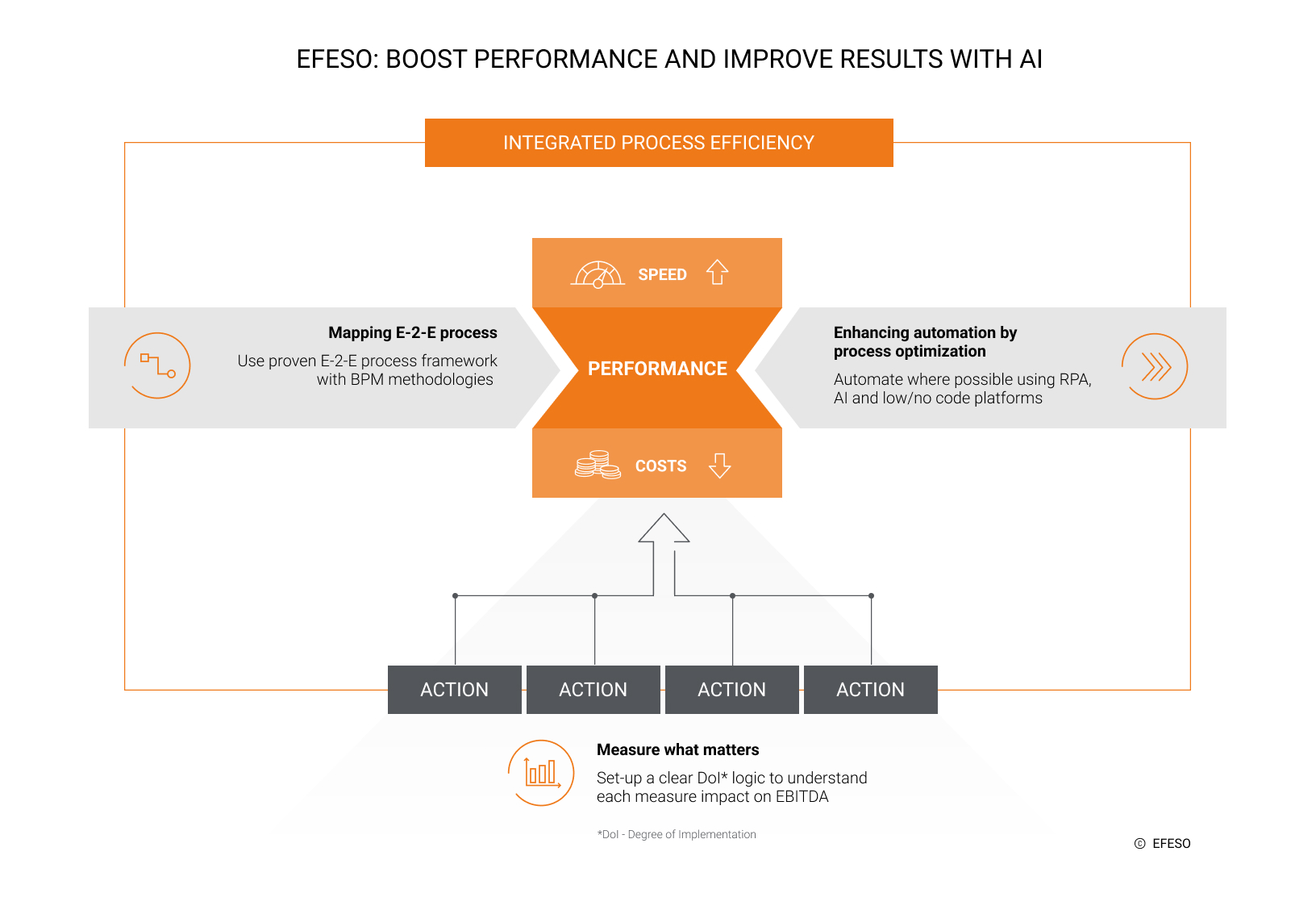
In parallel, EFESO established a degree-of-implementation methodology that links each measure to its measurable impact on speed, cost, and process performance (see graphic). Four elements enabled the approach to deliver results quickly while remaining scalable over the long term:
- End-to-end perspective: EFESO’s process experts provided full transparency into workflows, interfaces, and sources of instability. The team compared the findings with industry best practices, enabling it to prioritize improvements where they would have the greatest impact on speed, cost, and performance.
- Targeted use of AI: The Process Navigator handled repetitive documentation and analysis tasks, created process drafts, and generated new insights. The consultants assessed the context and ensured the technical relevance of the results.
- USA – Unify, Simplify, Automate: The team reduced process variants, eliminated loops, and standardized workflows before evaluating automation opportunities. In this way, EFESO applied technology specifically to stable and efficient processes.
- Measuring impact and transferring knowledge: Using the degree-of-implementation methodology, EFESO tracked each measure through to measurable results. At the same time, the team transferred the methodology and AI agents to the client, enabling the company to optimize additional processes independently.
Overall, the battery manufacturer will continue to benefit from the project’s results over the long term. Beyond delivering immediate improvements, the delivery model significantly strengthens the company’s ability to continuously improve its processes.