
Sharp pivot – clear results
A global player in the automotive industry cushions a market slump of up to 20% in a central product area with EFESO.
A performance program for a "holistic turnaround" is intended to secure a particularly margin-relevant division of an automotive supplier within three years and maintain profitability. To create the ideal starting conditions for this and to implement the program effectively, the Group's management has engaged the EFESO team.
Challenge
A global player in the automotive industry responds to market erosion and margin pressure with a performance program. Within three years, this should enable the organization of a division to increase margins.
MoreEFESO approach
The performance team created eight workstreams that covered all the key value drivers in the division and orchestrated them with a Performance Office (PerfO).
MoreLessons learned
Companies should initiate performance programs in time - before profitability is visibly eroded. After the start, the program will develop its optimal effect if accountability remains with the internal managers.
MoreEFESO success model
The program combined the "strategic management" and "operational support" levels. As a result, the project was managed "top-down" and progress was made towards implementation.
MoreWake-up call for a turnaround
Market turbulence and debt growth: in this case study, a Tier 1 supplier to the automotive industry experienced a stress test with double the pressure. As a key global player with more than 100,000 employees worldwide, the group manufactures essential components for cars and trucks. While it has to master the transformation to e-mobility, the company was also confronted with global stagnation and erosion of the truck market with a slump of more than 20%. More customers are relocating the production of key products (e.g. truck transmissions) to their own factories. The previous order volumes could not be maintained with the remaining specialized markets or new customers.
At the same time, a high need to reduce debt throughout the group exacerbated this difficult situation. As the division with the highest margins, the truck business in particular should continue to generate high and rising EBIT margins to support debt reduction.
The answer to market erosion plus margin pressure cannot be "business as usual".
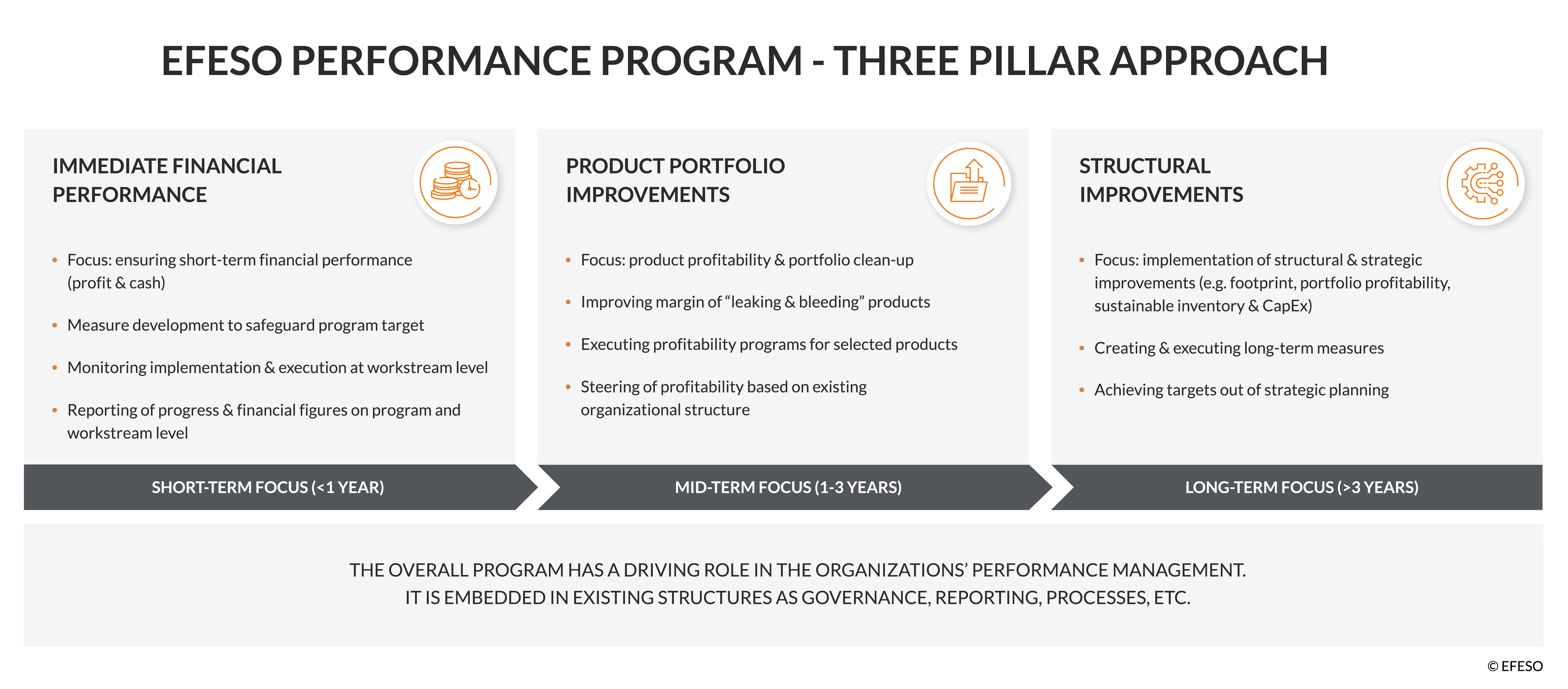
The company realized that the answer to this threatening combination of market erosion and margin pressure could not be "business as usual". The CEO and CFO of the division decided to take massive countermeasures with a comprehensive performance program. This should enable the division's organization to significantly increase margins within three years. In general, the program addressed the overarching areas of action "financial performance", "Product portfolio improvements" and "structural improvements" (graphic).
As a proven implementation partner from comparable initiatives, the group's management brought EFESO on board to create the ideal starting conditions for the program's success. The brief to the consultants was:
- Conception and design of the entire program with a holistic approach that covers all business areas and the entire value chain.
- Ensuring a smooth program start.
- Development of a reporting, tracking and control concept in close cooperation with the CFO.
- Support of the work packages for the organization in the start-up and implementation phase.
- Use of strategic levers per work package plus implementation of strategic improvements in separate additional programs.
From data to decisions to results
The set-up of the performance team already gave the automotive group an advantage. EFESO appointed seven consultants to the team: in addition to the main contact person for the CEO and CFO, a project manager and five other specialist managers. The latter were each responsible for a cluster of workstreams, e.g. Sales & Material, Operations & R&D or SG&A.
The team reported directly to the CEO and CFO on a weekly basis and to the entire management team on a monthly basis. However, the EFESO consultants only provided information on overall performance, while the workstream leads from the customer side presented their topics themselves. In contrast to comparable projects, this was intended to ensure that responsibility for results remained clearly within the organization: EFESO provided the methodology, structure, figures and content - but did not take ownership of the project in line with the principle of "helping people to help themselves". This approach also ensured that the company built up important skills among employees for long-term, continuous improvement.
Structure of the performance program & workstream
A PerfO (Performance Office) served as coordinator, pacemaker and supporter all in one. From here, the "drumbeat pulsed" throughout the entire organization, defining deadlines, expectations and formats - ensuring that the many individual initiatives did not become loosely linked projects, but rather a joint advance. Below this PerfO, eight workstreams were grouped together, covering all the key value drivers in the division:
- "Sales" looked at how value can be realized more consistently with customers - from enforcing prices to structured argumentation at the negotiating table.
- "Material" aimed to reduce material costs and laid the foundation for tangible savings along the supply chain.
- "Operations" focused on production itself: processes, throughput times, efficiencies - everything that dampens performance or generates commitment capital was broken down into individual "puzzle pieces" and reorganized.
- "Quality" worked in parallel on avoiding error costs and addressing them where they arise - including at suppliers.
- "R&D" put the Product portfolio to the test: which products deserve attention and investment in the future, and which need to be systematically streamlined or discontinued?
- "SG&A" focused on getting the organization into shape, i.e. making it leaner, clearer and faster.
- "Cash-to-Cash" should accelerate payment flows (receivables) and stretch them (payables).
- "Inventory & CapEx" focused on reducing capital commitment and improving investment discipline.
All in all, this resulted in a closed, effective system: each workstream visibly contributed to margin, liquidity and robustness. To clearly demonstrate the effectiveness of the approach, the performance team also took on the role of financial navigator. Year-on-year performance bridges made visible:
- how profit margins and cash flow develop from year to year;
- how opposing effects, volume and price fluctuations influence them;
- the impact of countermeasures that have been identified and are currently being implemented;
- what additional measures are necessary to achieve the group's goals.
This combination of orchestration and transparency also noticeably changed the management routine. The employees in the division did not experience a "control ritual", but benefited from a "learning system" that turned data into decisions and decisions into results.
The project team scrutinizes all key value drivers in eight workstreams.
Leadership through clarity
During the implementation of the project, the following empirical values proved to be particularly critical to the success of the cooperation between the external consultants and internal specialists in the performance team:
It is better to act early than in crisis mode!
Companies should launch performance programs in good time, ideally before profitability visibly erodes. If you wait until a crisis becomes acute, you lose valuable options for action and the necessary calm to implement structural changes properly.
Maintain a strict "drumbeat"!
Clear timing of deadlines and delivery periods for each workstream in the organization is only one side of the coin. This only has an effect if there is a sharp escalation in the event of non-compliance. The tone in the company therefore becomes harsher at times, but this is necessary for success. At the same time, the program must be prioritized strictly above day-to-day business so that measures do not fizzle out.
Leave & anchor the responsibility for results in the organization!
A performance program only achieves its optimum effect if accountability remains with the internal managers. External consulting may support, structure and empower, but does not replace operational responsibility. This is the only way to create sustainable change.
Turning pressure into future security
The professional commitment of the EFESO consultants ensured rapid results and impact on the way to the EBIT target. The division achieved its savings targets in the materials management segment, for example, which would not have been possible without the program. Despite the massive external pressures, the performance team was able to achieve significant stabilization overall. This resulted esp. from these aspects:
Use of proven methods & tools
The effectiveness of the program was largely based on the methodology and the wide range of tools that the EFESO team brought to the organization. It was clear from the outset that it would not be enough to simply create structures; the organization needed concrete tools to support the content of the ambitious performance program.
This resulted in a comprehensive set of tools that enabled both the management of the overall program and the operational work within the individual workstreams. This included a robust reporting and controlling system that could map complex performance bridges, as well as clear organizational structural elements: timing, coordination logics, escalation mechanisms and defined expectation horizons. This architecture gave the program the stability it needed to have a consistent impact over a period of months.
Targeted empowerment of the workstreams
At the same time, each workstream was equipped with its own deeply rooted methods. In procurement, for example, with a material cost optimization program that enabled the organization to identify and realize potential savings in a structured manner. In the area of sales, tools such as systematic inflation controlling and analyses of contribution margins and margins were introduced in order to clearly identify "leakers and bleeders". In R&D, on the other hand, a comprehensive portfolio analysis helped to harmonize investments, customer requirements, and technological attractiveness - and thus derive reliable strategic decisions on the Product portfolio for the first time.
Even where the organization did not make immediate progress in terms of content, the team provided concrete content and coaching to develop and successfully implement measures. This combination of structure, methodology and depth of content resulted in a program that was both systematic and operationally effective.
The EBIT margin fell by approx.6% instead of more than 20%.
Combination of strategic management and operational support
A key difference to traditional consulting approaches was the understanding of responsibility and the type of cooperation. While strategy consultancies often take on the orchestration but leave the content very much to the organization, this program combined both levels: strategic management and operational content support. As a result, it was not only possible to lead "from above", but also to generate progress "in depth", right through to operational implementation.
It was precisely this combination - strong structure, in-depth technical expertise, and the simultaneous empowerment of the organization - that became a clear differentiator. In comparison to purely top-down driven programs, it was possible here to actually hold managers accountable, but at the same time to support them in such a way that they were able to fulfill this responsibility effectively. This approach not only delivered short-term results. It also enabled the company organization to continue the successfully launched transformation independently in the long term.