
The perfect operations day as a benchmark
Methodology, mindset and culture rethought: a pharmaceutical manufacturer accelerates the transformation of production at one of its plants.
A chemical and pharmaceutical group takes the topic of “Operational Excellence” to a new level. Together with EFESO, the production of pharmaceuticals is optimized in a pilot project. At the same time, a Leadership Excellence program with elements such as a workshop on the “Perfect Day” enables managers to anchor OPEX in the corporate culture beyond the production line.
Challenge
A global market leader in the process industry continues to develop its production organization in the spirit of “Operational Excellence”. The focus is on production lines operating in a three-shift model.
MoreEFESO approach
The project team pursued a solution approach that brought two dimensions into alignment: methodology was harmonized with the topic of “mindset & culture”.
MoreLessons learned
Operational Excellence requires more than method competence – it is the combination with leadership and cultural aspects that creates the decisive successes in everyday operations.
MoreFrom method fixation to a change in perspective
With a history of more than 150 years, the group is among the global market leaders in the process industry. Accordingly, the quality and performance levels already achieved in terms of “Operational Excellence” within the company were very high when it launched a joint project with EFESO.
The overarching objective was to make the production organization even safer and more effective in the operational environment. Specifically: to increase efficiency in one pharmaceutical production line, further improve quality, minimize loss rates and thus ensure reliable production of the right product at the right time and with the right quality. The ambition was nothing less than a “gold standard”: starting with a lead plant in Europe, successful methods and results were to be scaled to additional sites with comparable production environments.
In this case, the project team consisted of five decision-makers from the group as well as eight consultants from EFESO. On the company side, representatives included, for example, the head of Operational Excellence, as well as leaders from Quality, Maintenance, Training & Development and the operational production areas. To achieve the defined objectives, the project team introduced or complemented classic manufacturing and lean methods such as structured problem solving, A3 and Ishikawa. Initially, it focused on the production organization with line leads and shift leads who were responsible for the production lines operating in a three-shift model. It quickly became clear that during the project phases the team had to address three key challenges that are also typical in discrete manufacturing:
Limits of methods must be recognized and overcome
Before the project, the development of know-how in production focused on establishing and training structured problem solving and lean tools. However, one very important aspect was overlooked: methods and mindset develop further as ONE unit and must therefore be considered and “adjusted” together, for example when production conditions change rapidly. If instead one implements “tool after tool”, a natural limit is reached: employees will eventually apply the tools mechanically without questioning their value. At the same time, the risk of “method fixation” arises – the well-known dilemma: if the only tool in your toolbox is a hammer, every problem looks like a nail.
Expanding leadership competencies
The career path of many managers in the plant was based on technical excellence: the stages of top employee on the line, team lead and finally line lead / manager were the standard progression. With each step, the share of operational work decreases, while essential leadership tasks – such as coordinating and communicating – increase. Accordingly, leadership competencies must be systematically developed further in order to proactively address issues such as insecurity in the leadership role, lack of experience in employee conversations, or overload due to administrative tasks.
Addressing and resolving value and role conflicts
Managers often come into conflict with their own values when they have worked in a plant or department for many years and change hierarchical levels within the same team constellation. Colleagues must then be evaluated, for example according to the principle of “forced distributions”, such as through the 9-Box Talent Grid (performance × potential). If a manager struggles with this, it can lead to conflict with their role, make them less clear about what they do – and therefore cause them to no longer be perceived as authentic by the team. In this context, reflecting on one’s own role, for example in 1:1 leadership coaching, can be helpful.
In addressing these demanding challenges, EFESO as the implementation partner contributed a unique combination of expertise: the consultants were able to combine the technical-operational dimension of the project with the “mindset” dimension based on their experience from comparable projects. Both are necessary for management excellence.
Methods and mindset develop further as ONE unit.
Interaction between tools and mindset in focus
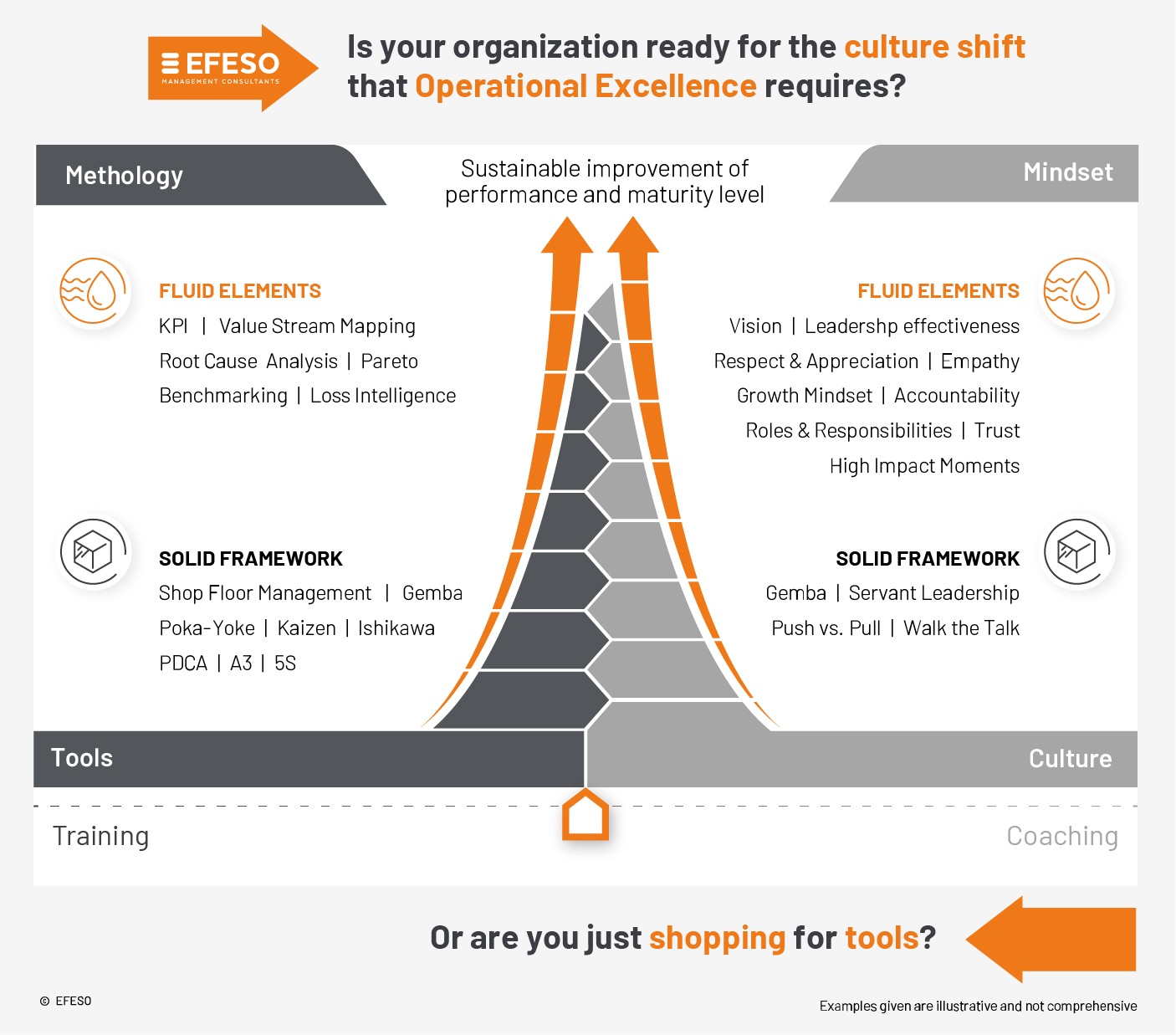
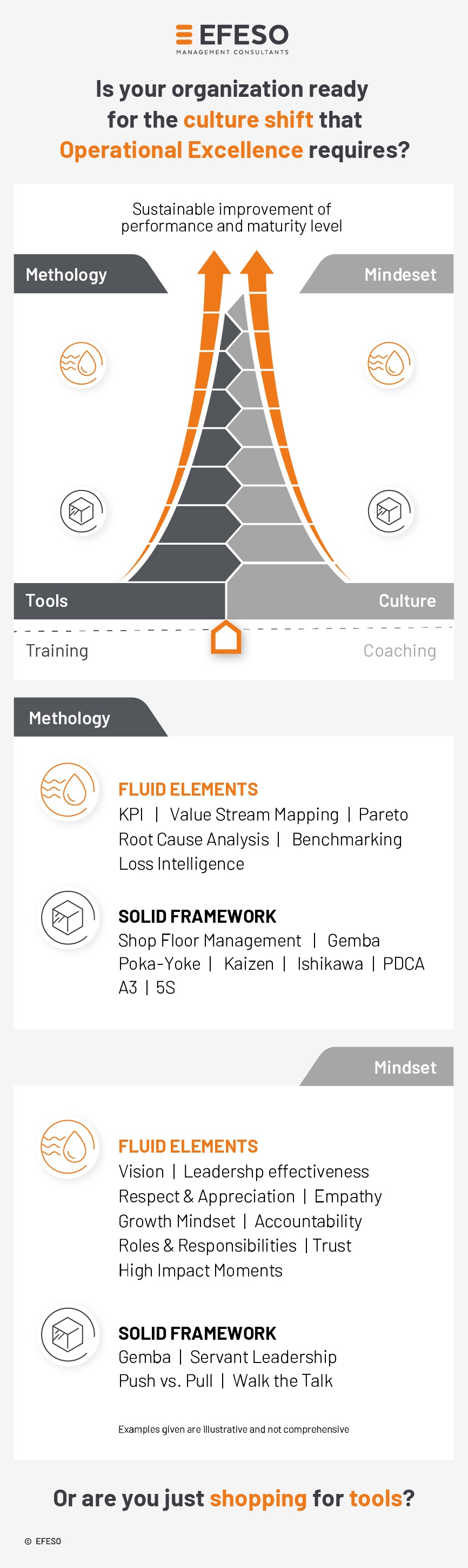
The project team pursued a solution approach that brought two dimensions into alignment: methodology (tools) – such as the introduction or further development of A3 problem solving, lean, meeting structures and operational excellence tools – was harmonized with the topic of “mindset & culture” and developed further accordingly. The focus was on coaching and training in the area of “Leadership Excellence” (see graphic). The following key aspects and elements were applied:
Slider model of transformation
As a starting point, the team took into account that transformation projects – such as OPEX in manufacturing in this case – are typically shaped by the methodology applied. Therefore, from day one the team ensured a balance between OPEX trainings (learning methods, establishing structured processes) and the further development of the responsible managers in the plant.
This Leadership Excellence program included in particular 1:1 coaching of managers by EFESO experts as well as a systematic reflection on leadership roles (both individually and within the organization). This approach provided the decisive and effective impulses for developing and anchoring a new mindset of continuous improvement among employees in production.
Leadership Excellence program
In total, 28 managers at the plant further developed their competencies within EFESO’s Leadership Excellence program over a period of eight months. The program began with a workshop in which, as preparation for the leadership program, participants identified their individual “position” and reflected on leadership roles. The “core topics” were then addressed in individual coaching sessions with approximately ten sessions per manager.
Leadership philosophy
In line with a leadership philosophy, the coaching focused on the following aspects: first, the values and personal motivation of the manager; second, the target space of current competencies; third, the “development space”, meaning the identification of capabilities that still need to be developed.
Here the EFESO coaching follows a clear premise: people do not primarily work on goals – they work on goals in order to fulfill their values. In addition, within this systemic approach EFESO coaches do not focus on so-called “deficits”; rather, the aim is to restore access to resources that enable the manager to work (and lead) authentically.
People do not primarily work on goals – they work on goals in order to fulfill their values.
Individual solutions for managers and corporate cultures
During the project, the following lessons learned proved particularly valuable for the organization:
Even the best tool is no guarantee of success!
Operational Excellence requires more than methods (competence) – the combination and balancing with leadership and cultural aspects is crucial. Only when employees understand the underlying principles, take responsibility and anchor continuous improvement in their daily work do methods and tools unfold their full impact.
Managers act more confidently in new roles thanks to coaching!
The greatest challenge in a role transition arises when moving from technical expert to manager. Without targeted development, this often leads to misunderstandings and ultimately to overload. It should not be underestimated what organizational impact individual coaching can have in total, particularly with regard to implementation speed, performance, employee satisfaction, sustainability of implementation and organizational development.
Culture is organization-specific!
There is no universal culture strategy. Transformation must always be adapted to the maturity level of the organization, the personnel structure and the corporate context. What works in one company may remain ineffective in another, because values, leadership styles and informal rules are shaped and lived differently everywhere. Culture is the sum of relationships within a space – in this case within the organization.
A joint analysis revealed several structural challenges.
More efficient work and leadership processes
Concrete operational improvements in the daily work routines of the plant led to important success experiences in this case study. One particularly effective format proved to be the workshop “The Perfect Day”: during this workshop, the production teams jointly defined what an ideal working day should look like. They discussed which roles are involved and which information is required at which point in time to ensure smooth cross-functional collaboration.
This joint analysis revealed several structural challenges, for example in the areas of production planning or shift handovers. In addition, many meetings turned out to be redundant: often more people participated than actually necessary, and information was shared inefficiently or too late.
Based on these insights, the project team was able to counteract with targeted measures. One change that quickly showed results was the introduction of a clearly structured meeting cascade: clear roles were defined for each meeting and the number of participants was deliberately reduced – meeting guidelines for each meeting were developed and implemented operationally. At the same time, the team systematized the flow of information so that employees now pass on relevant content in a targeted way from one level to the next. One example of the effectiveness of this approach is the sequence of shift handover, the subsequent daily meeting and the overarching weekly meeting. This created a clear flow of information across all levels. The production team benefits from more efficient communication, clearer responsibilities and avoids unnecessary, time-consuming coordination.
The OPEX & Leadership Excellence program implemented for the plant led to measurable improvements at both the operational and cultural levels. Operationally, higher leadership efficiency, improved OEE values, lower scrap rates and a lower absenteeism rate were observed. At the same time, cultural factors also developed positively. Employee satisfaction increased, managers were rated more positively in internal evaluations and the organization gained overall structural maturity.